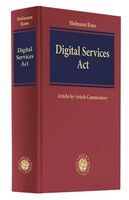

Digital Services Act
Vorgelegt ist in englischer Sprache ein Kommentar des DSA. Mit dem Titel und den Herausgebern hat man das vor knapp zwei Jahren schon einmal in deutscher Sprache auf dem Tisch gehabt. Die große Frage war also, ob die Kommentierung nun fortgeschrieben ist mit den ersten Erfahrungen der Praxis und der Diskussion, die sich weiter gedreht hat. Vielleicht waren die Stichproben zu gering oder es waren die falschen Textstellen, die zur Vorbereitung dieses Literaturhinweises verwendet wurden - es fand sich die wortwörtliche Übersetzung. Ob an Einzelstellen dann doch Ergänzungen vorgenommen wurden, ist schwer zu sagen, da wir eben nicht den ganzen Text nebeneinander durchgeblättert haben. Jedenfalls waren in den Stichproben auch die Randziffern unverändert.
Die deutschsprachige Leserschaft ist also klar im zeitlichen Vorteil. Der "deutsche" Kommentar - gemeint: die Kommentierung aus der rechtlichen Perspektive, die wir im Inland pflegen - nun auch für die Nutzung in den anderen EU-Mitgliedsstaaten in englischer Übersetzung vorliegt, ist sehr zu begrüßen. Nur so gelingt es, nachhaltig in der internationalen juristischen Diskussion Gehör zu finden.
Für die Buchvorstellung ist das alles ein wenig ein Problem. Daher sind auch wir den Weg gegangen, den deutschen Text von damals ins englische zu übersetzen - mit DeepL, also ein wenig burschikoser als die sorgfältige Übersetzung der namhaften Verlage.
An heavyweight is to be presented - in every respect. Around 1200 pages of commentary on the Digital Services Act (DSA) is a comprehensive and sometimes certainly courageous undertaking, in which editors and authors have joined forces. Much has not yet been clarified as to what the DSA means for those applying the law, especially in Germany. Which brings us to the first topic: one should not read it through the lens of a member state – in this case, Germany. European legal norms are to be interpreted and understood on their own terms, but the German translations tempt one to base one's understanding on German legal concepts. A mistake, the commentary says in the introduction. In some cases, translations are not even consistently applied within individual norms. Therefore, all articles of the DSA are printed in English and French in addition to the German language version, so that text comparisons can be made, which then also happens in the individual commentaries as needed.
The DSA, which deals with platforms (in a tiered manner), potentially conflicts with other regulations. For example, the relationship to Art. 17 DSM-RL and thus in Germany to the corresponding implementation in the UrhDaG is emphasised. We recall that this is the provision that supposedly caused the internet as we knew it to disappear – but then it didn't, just because user-generated content portals are held accountable in copyright law. The copyright regulation is therefore the special one, and the implementation that has taken place here takes precedence. This immediately raises questions about how the scope of the respective regulations is understood and, according to the commentary, still has a great deal of potential for controversy.
The DSA also contains ’liability privileges’ for platforms, as previously existed in the E-Commerce Directive and were then deleted. At first glance, this is not yet revolutionary and the EU Commission assumes that the existing case law of the ECJ can continue to be relied upon, the commentary reports. However, there may be a slight shift in the respective member state, because it is no longer the national implementation of the previous directive that must be taken into account; instead, the DSA applies directly as a regulation.
This draws attention to ’other provisions on due diligence’ (we will ignore the famous German ’störerhaftung’ at this point). Art. 44 et seq. DSA deals with due diligence obligations that are formulated as co-regulation. For example, it mentions voluntary codes of conduct at the Union level that serve to combat various types of illegal content and systemic risks. So far, there is a code of conduct to combat hate speech online (2016) and one to combat disinformation (2022) – the latter has recently gained notoriety because the head tweeter let it be known that he does not think much of it and does not adhere to it either. In the future, the Commission will in any case be able to pressure very large search engines and platforms to comply with such rules. The commentary sees the embedding of ’voluntary’ codes in the supervisory structure as more far-reaching than other secondary legislation – ’promote’ is more than ’encourage’ when it comes to the Commission's ability to act against platforms to comply with codes of conduct. The comments also address, among other things, whether a violation of a code can trigger compensation claims against users, or whether this is only the case if mandatory duties of care are violated.
In many parts of the commentary, one gets the impression that a great deal of detailed work is still needed by the Commission and the participating national authorities and their coordinating function at the European level to bring the DSA to life. The commentary has the great merit of highlighting the applicable framework and identifying the areas in which further discussion is needed.
Franz Hofmann
Benjamin Raue (Hrg.)